


Geopolitics of chaos
On a path toward global confrontation
Frederico Carvalho
99th Executive Council of the World Federation of Scientific Workers
9–11 February 2026 (online)
Working Group 1: “Peace, Development and Cooperation”
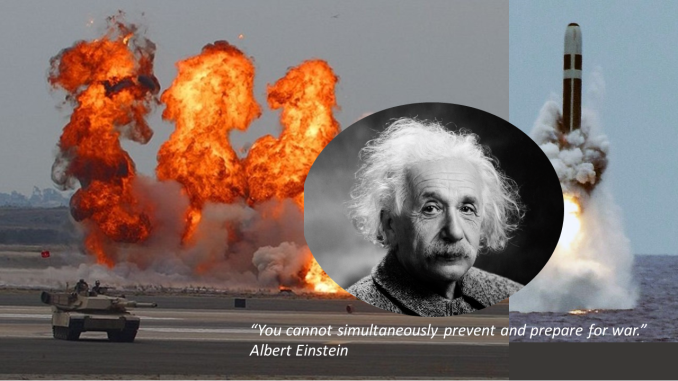
“You cannot simultaneously prevent and prepare for war.”
Albert Einstein
We are witnessing developments on the world stage on an almost daily basis which in most cases can hardly be seen by our fellow citizens as good omens.
In Europe the roots of instability laid out in the aftermath of the second world war have come to bear tragic consequences in the first quarter of the present century. In the case of the tragedy that is underway in Eastern Europe they are to be found in the agreement cheated on by the US that led to the unification of Germany and, subsequently, to the gradual but persistent expansion of NATO to the east. In 1990, the then American Secretary of State James Baker, the Third, said to Michael Gorbatchev, “NATO will not move an inch eastward if you agree to German unification” basically ending World War II. This exchange has been recorded and is confirmed by the classified official documents released in December 2017 by the United States National Security Archive (NSA).
The rapid, large-scale eastward expansion of the so-called defensive alliance took hold after the 1991 dissolution of the Soviet Union, leading to 10 distinct rounds of enlargement by 2024. In 1994 Clinton had signed a plan to basically expand NATO all the way to Ukraine. This was perceived by the Russian Federation as the crossing a definite redline. The US led regime change operation in Ukraine in 2014 was seen as a bold step towards achieving that goal.
War mongering, promoting and engaging in armed conflicts has been for the past two centuries a distinctive pattern of the behaviour of the major western powers including old colonial powers. In this respect the role of the United States of America is particularly remarkable. Since the end of World War II, there have been a total of 100 well documented interventions in foreign countries including the so-called regime change operations and the more recent “color revolutions,” wars, and coups. Seventy documented U.S. regime change operations took place during the Cold War era, 64 of which were covert operations and 6 overt attempts at regime change. Referencing historian John Coatsworth[i], Professor Jeffrey Sachs, of Columbia University, has highlighted that the U.S. led 41 successful regime changes in Latin America alone over roughly a century, averaging one overthrow every 28 months.
In seeking to understand the current state of the world, it is important to look at events that marked the first quarter of the present century. On September 2001 it was decided that seven wars would be launched over five years. General Wesley Clark who was Supreme Commander of NATO from 1999 to 2000, went to the Pentagon on September 20, 2001, where he received the document explaining the seven wars. These were “Israeli Wars”. According to Professor Jeffrey Sachs[ii], the nations targeted in this U.S.-led, Israeli-supported strategy of intervention were Iraq, Syria, Lebanon, Libya, Somalia, Sudan and Iran. Sachs argues that the U.S. has engaged in conflicts in six of these countries, often under the guise of democracy promotion, but in reality, to destroy nations that could challenge American and Israeli dominance in the region. He notes that to the “consternation” of Israeli Prime Minister Benjamin Netanyahu, the war with Iran is the only one on the list that has not yet been fully realized[iii].
It is transparent that the guidelines of the foreign policy of the United States have remained essentially consistent for the last 80 years. This is to a large measure independent of the person that holds the post of President. The main forces that determine the policies pursued lay in the background. One should recall with admiration the 1961 farewell address of Dwight Eisenhower to the American people as he left the Presidency. Eisenhower highlighted the risks of “unwarranted influence” by the combined power of the defense industry, military, and government, warning that it could undermine both American democracy and economic stability. He anticipated not only the military-industrial complex but also the potential for a “scientific-technological elite” to dominate public policy through government funding.
These are concerns that remain valid in our days. We might add that the impact of these “underground” agents on the public affairs has never been so huge. One should not think however that such a state of affairs is peculiar to the USA. In the western world and to some degree beyond it, the interests of big corporations and of a small number of multibillionaires have an outsized influence over global economic and political systems [iv]
One particular and deeply disturbing aspect of the present state of affairs is the growing influence of political and private interests on the scientific endeavour. It conditions the progress of science, twarths its path and puts in danger the ethical control of innovation. Some aspects deserve particular attention. One is the growing footprint of the military in academic and research institutions. One well documented case is that of the United Kingdom thanks to the in-depth analysis carried out by our fellow association “Scientists for Global Responsibility” that highlights the increasingly close relationship between the military-industrial complex and the academic sector in Britain. In the US a policy although clearly harmful to the national interest is pursued that imposes severe budgetary cuts affecting both prestigious research universities and a number of government agencies that are active in critical domains of the life of society[v]. It is the case of the National Institutes of Health, the Environmental Protection Agency (EPA), the National Oceanic and Atmospheric Administration (NOAA) or NASA, the National Aeronautics and Space Administration. The case o AI — a socially disruptive technology [vi]— is particularly relevant. In short, the Trump administration has reduced public, foundational, and regulatory-focused AI funding while prioritizing private-sector-led infrastructure development and loosening regulatory constraints on AI companies. Attacks on the public sector are clearly selective and follow general political orientations such as the denial of climate change.
Another important issue that should be brought to attention are restrictions of academic freedom and more generally freedom of expression occurring in different countries, with recent reports indicating a global decline in these rights. Data from the 2024 and 2025 Academic Freedom Index (AFi) shows that academic freedom is eroding not only in authoritarian regimes but also within established democracies. In Europe the cases of Germany and the United Kingdom are indeed relevant in this respect.
As is commonly accepted with due reason scientific endeavour can only prosper globally in a background that favours free cooperation and interchange on the international level. Severe obstacles are being risen to both as a consequence of an accelerated arms race assorted with growing economic competition. This announces a grim future for the world contrary to what would be required to advance the United Nations Sustainable Development Goals.
It is difficult to believe that the situation will keep evolving for much longer along the path it is following at present. There are reasons to believe that either the present state of affairs is profoundly changed or that path will lead to disaster. On the eve of the expiration of the last nuclear arms reduction treaty that subsists — the NEW START — the spectre of nuclear war cannot be dismissed [vii]. The question is whether the powers that be will recognize the danger and the need to definitely restore an environment that allows for a minimally sane improvement of an understanding between them that brings an end to ever-lasting conflicts.
Frederico Carvalho
January 29th, 2026
__________________________________________________________
Top image credits: Albert Eintein — Orren Jack Tu
___________________________________________
[i] “United States Interventions. What For?”, John Coatsworth, May 15, 2005 (https://revista.drclas.harvard.edu/united-states-interventions/ ), see also “Covert Regime Change: America’s Secret Cold War”, David Foglesong, Rutgers, The State University of New Jersey, December 2019, Journal of American History 106(3):818-819
(https://www.researchgate.net/publication/345387553_Covert_Regime_Change_America’s_Secret_Cold_War)
[ii] Jeffrey Sachs, economist and political analyst, taught at Harvard for nineteen years. Today, at Columbia University, he directs the Center for Sustainable Development. Jeffrey Sachs is also one of the 17 “Advocates for the Sustainable Development Goals (SDGs) of the United Nations” appointed by Secretary-General António Guterres. https://www.youtube.com/watch?v=yxcumWif6E0
[iii] The war, which is currently raging, began after this intervention had already taken place
[iv] As of early 2026, the world has seen a record rise in the number of billionaires, with the total exceeding 3,000 for the first time. The concentration of extreme wealth has led to discussions regarding the emergence of a “global oligarchy”.
[v] In the US the proposed cuts for the Fiscal Year 2026 amount to a slash of over one third of Government’s spending both in basic and applied science
( https://www.universityworldnews.com/post.php?story=20250718232924845#:~:text=The%20Defense%20Agencies%2C%20which%20include,environment%2C%20or%20clinical%20setting%E2%80%9D)
[vi] AI is one of the technologies that has been recently seen as such by the Scientific Committee of the Doomsday Clock that decided on the 27th of January last to advance by 4 seconds the handle of the minutes of the Clock, now at 85 seconds to midnight.
[vii] On 4 February 2026, the New Strategic Arms Reduction Treaty (New START) is due to expire. If it does, it will mark the first time since the early 1970s that there will be no legally binding limits on US and Russian strategic nuclear forces without another agreement being under negotiation.
(https://www.chathamhouse.org/2026/01/us-and-russias-nuclear-weapons-treaty-set-expire-heres-whats-stake)
________________________________________
PDF Document (English – French): WFSW99EC-WG1-Paper 2-FC_ML_2026-En-Fr
Article on the FMTS-WFSW website:
EN: https://fmts-wfsw.org/2026/04/geopolitics-of-chaos/?lang=en
FR: https://fmts-wfsw.org/2026/04/geopolitique-du-chaos/


