


History of the World Federation of Scientific Workers (WFSW)
15 July 2026
By tracing the history of the World Federation of Scientific Workers (WFSW), this article revisits a question that is more relevant than ever: between the pursuit of knowledge and civic responsibility, to what extent are scientists responsible for their discoveries in the face of pressure from the military-industrial complex?
André Jaeglé
Honorary President of the World Federation of Scientific Workers (WFSW)
President of the WFSW from 1997 to 2009
After organising the Allied landings in Normandy in June 1944, Dwight David Eisenhower, President of the United States from 1953 to 1961, became the first to denounce the military-industrial complex.
Scientists such as the physicist Paul Langevin and others put their knowledge at the service of national defence during the First World War, contributing to what later became sonar. He was not alone. He was simply fulfilling his duty as a citizen.
But was it still a citizen’s duty to allow research into artificial radioactivity to continue at a breathtaking pace when Frédéric Joliot-Curie, who shared the 1935 Nobel Prize in Chemistry with his wife Irène Joliot-Curie, and several others became aware that such research would inevitably lead to the development of weapons of mass destruction? In the mid-1930s, he and others, including the Hungarian-American physicist Leo Szilard, considered withholding the results of their research from publication. They soon abandoned the idea as unrealistic.
SCIENTIFIC RESEARCH PLEADS GUILTY
Fast-forward 90 years, and in 2025 the journalist and historian Nicolas Chevassus-au-Louis published a short book entitled Décroiscience. “If science is not the cause of all our ills, it plays an important role. Particularly in economic growth. […] Should we therefore continue scientific research? Or should we instead consider ‘décroiscience’? A voluntary and controlled reduction in scientific research. The question is irritating, but it deserves to be asked.” Such concerns should not be taken lightly. The need to know and understand is far stronger than any political decision based on ideology. UNESCO’s recent adoption of its Recommendation on Open Science (2021) arose precisely from a response by the scientific community and civil society to the growing obstacles to access to scientific information. Nicolas Chevassus-au-Louis’s book provides a concrete and detailed description of the economic-scientific complex, not merely the military-industrial complex. This is its merit.
In 1974, UNESCO’s General Conference adopted the Recommendation on the Status of Scientific Researchers (revised in 2017). This document addresses the issue by recognising: “a. that scientific discoveries and related technological developments and applications open up vast prospects […] for the benefit of humankind and for the preservation of peace and the reduction of international tensions, but may, at the same time, entail certain dangers which constitute a threat, especially in cases where the results of scientific research are used against humankind’s vital interests for the preparation of wars of mass destruction […] and may, in any event, give rise to complex ethical and legal problems; b. that the free communication of results, hypotheses and opinions – as suggested by the expression ‘academic freedom’ – lies at the very heart of the scientific process and provides the strongest guarantee of the accuracy and objectivity of scientific results; […]“
Not only is the ethical dimension recognised in what had become a political struggle, but the corresponding rights are also explicitly formulated. Article 14 states: “Member States should endeavour to promote conditions in which scientific researchers, with the support of public authorities, have the responsibility and the right:
- to work in a spirit of intellectual freedom to pursue, expound and defend the scientific truth as they perceive it;
- to contribute to the definition of the aims and objectives of the programmes in which they are engaged and to the determination of the methods to be adopted, which should be consistent with their human, social and ecological responsibilities;
- to express themselves freely on the human, social or ecological value of certain projects and, ultimately, to withdraw from them if their conscience so dictates;
- to contribute positively and constructively to science, culture and education in their own country, as well as to the achievement of national objectives, the improvement of the well-being of their fellow citizens and the realisation of the international ideals and objectives of the United Nations; it being understood that Member States should, when employing scientific researchers, specify as precisely and narrowly as possible the circumstances in which they consider it necessary to depart from the principles set out in subparagraphs (a) and (d) above.“
A SCIENTIFIC AND CIVIC ETHIC
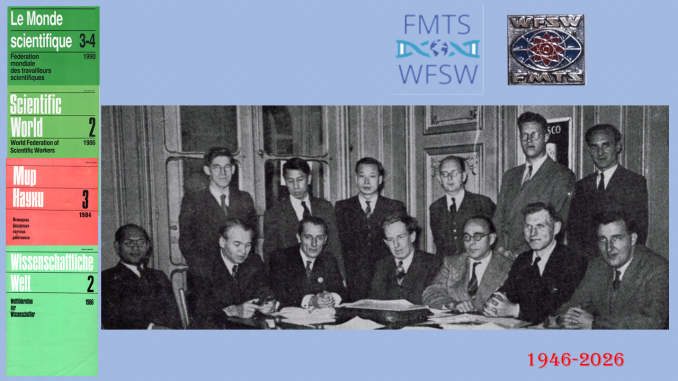
This UNESCO Recommendation reflects, in the language of international diplomatic instruments, provisions expressed in trade-union terms in the Charter for Scientific Workers, originally published in English by the World Federation of Scientific Workers in 1948. The World Federation of Scientific Workers (WFSW) had been founded two years earlier, in July 1946. The preamble to its Constitution states, in its opening sentence: “The primary aim of the scientific organisations adhering to the Constitution of the World Federation of Scientific Workers is the improvement of human welfare through the application and development of science. Scientists can no longer passively accept the misuse of science, which not only causes unnecessary suffering and waste but also hinders the progress of science itself.”
The preamble concludes: “The members of the World Federation of Scientific Workers believe that the only way to prevent mass destruction resulting from the misuse of science is to eliminate war as an instrument of national policy. War, or the threat of war, can only be prevented if the peoples of the world understand the causes of war and are able and willing to ensure that these causes are eliminated. Science, properly applied, can eliminate or reduce poverty, disease and ignorance, which still remain, to some extent, among the causes of war. International organisations established to combat these evils will receive the full support of the WFSW.“
THE WFSW: SCIENTIFIC DIPLOMACY
The WFSW thus began its existence on solid foundations. In France, the National Union of Higher Education and Research (SNESR), affiliated with the National Education Federation (FEN), decided to join the WFSW. A short-lived Association of Scientific Workers (ATS) was established. The journal Travail & Technique (1946–1956), published by the General Confederation of Labour’s (CGT) confederal grouping of engineers and senior executives, opened its pages to the WFSW. The Federation subsequently signed a cooperation agreement with the World Federation of Trade Unions (WFTU). However, this was before the outbreak of the Cold War. A few years later, the Federation’s Executive Council decided to suspend the agreement. Its President, Frédéric Joliot-Curie, strongly opposed any attempt to align the Federation with either of the two Cold War blocs, socialist or Western. The CGT did not join the WFSW until 1961, through a Scientific Workers’ Union (UTS) bringing together what is now the SNTRS and researchers and higher education teachers affiliated with the FEN. The UGICT-CGT became strongly involved in the WFSW in the aftermath of the movements of 1968. Several milestones help illustrate the role of this international NGO, an official partner of UNESCO.
In 1954, the WFSW’s Fourth General Assembly decided to organise an International Conference on Science and began establishing a broad sponsoring committee. On 9 July 1955, Frédéric Joliot-Curie signed the Russell–Einstein Manifesto, which denounced the dangers posed by nuclear weapons and called on the world’s principal leaders to seek peaceful solutions to international conflicts. The invasion of Hungary by Soviet troops at the end of 1956 led to the collapse of the sponsoring committee for the conference, which had been scheduled for early 1957. Nevertheless, a meeting took place in July 1957 in Pugwash, Nova Scotia, Canada. It resulted in an appeal signed by eleven leading scientists, including Cecil Powell, winner of the 1950 Nobel Prize in Physics and a future President of the WFSW. This appeal gave rise to the Pugwash Movement. Throughout the Cold War, the WFSW became an almost unique forum for East–West dialogue. It regularly organised international conferences addressing the many specific issues encompassed by the broader question of “confrontation or cooperation”. The Federation facilitated discreet exchanges between Soviet and American scientists during negotiations on the control of underground nuclear testing. A symposium on ABC weapons (atomic, biological and chemical) was held in Berlin in November 1971. Jules Moch, a former French Socialist minister, took part. A WFSW delegation travelled to Vietnam to bear witness to the effects of Agent Orange. Jean-Marie Legay, who would later become President of the WFSW, was among its members.
ROBERT OPPENHEIMER AND THE SUPERBOMB
In 1942, at the launch of the Manhattan Project, the question arose of whether to develop not only the atomic bomb but also a nuclear fusion bomb. The idea was not pursued. However, in 1947, the Atomic Energy Commission (AEC) reconsidered the question. “Should an immediate, all-out effort be launched to develop a weapon capable of releasing between one hundred and one thousand times more energy than the existing bomb, with a destructive potential twenty to one hundred times greater?”
The AEC referred the matter to its General Advisory Committee (GAC), chaired by Oppenheimer, who had served as scientific director of the Manhattan Project. It should be emphasised that the GAC was explicitly a scientific committee. Its members were asked for their opinion because of their scientific expertise.
The GAC delivered its opinion in October 1949, opening with the recommendation: “We recommend against undertaking such an effort.” It then set out the reasons for this recommendation. The first was: “The belief that the extremely grave dangers to humanity inherent in this proposal far outweigh any military advantage that could be gained from such a development […] The reason for building such a weapon would be to acquire the capacity to devastate a very large area with a single bomb. Its use would involve a decision to massacre large numbers of civilians.”
This consideration combines a humanistic choice with a perspective drawn from military strategy. It does not depend specifically on scientific expertise. However, the argument is developed further: “It must be understood that this is a superweapon; it belongs to a category entirely separate from that of the atomic bomb.” This is a scientific assessment. The members of the GAC were best placed to recognise this fundamentally new characteristic and, at the time, may have been the only people capable of doing so.
A scientific consideration is nevertheless introduced in support of the preceding argument: “We are concerned about the possible global effects of the radioactivity generated by a few superbombs of conceivable magnitude.” Some twenty years later, Andrei Sakharov would pay a heavy price for his own refusal to endorse his country’s nuclear tests, because of the certain worldwide increase in radiation-induced diseases.
The GAC’s second consideration was: “The existence of such a weapon in our arsenal would have major consequences for world opinion: responsible people throughout the world would realise that the existence of a weapon of this kind, whose destructive power is essentially unlimited, represents an intolerable threat to the future of the human species. We therefore believe that the psychological effect of this weapon would be contrary to our interests.” This is a political opinion (what is or is not contrary to our interests), combined with a scientific warning (essentially unlimited destructive power) and accompanied by a humanistic conviction (an intolerable threat to the future of humanity). Those speaking are no longer merely experts, but citizens whose knowledge and long involvement in discussions of these issues have made them more aware than other citizens of certain implications. These scientists refuse to confine themselves to the role of experts. In any event, such a position would not have been accepted: on 31 January 1950, three months after they had signed and submitted the opinion under discussion, Secretary of State Dean Acheson asked the members of the GAC not to resign and not to make public statements. A friendly piece of advice.
The third consideration stated: “We believe that the superbomb should never be manufactured. Humanity would be much better off if there were no demonstration of the feasibility of such a weapon until the present climate of world opinion changes.” The significance of this consideration must be understood in relation to the debates taking place at the time on limited containment and deterrence.
The fourth consideration finally provides us with a purely scientific assessment. However, it proved to be wrong: “It is by no means certain that this weapon can be developed, nor that the Russians will produce one during this decade.”
The opinion concludes: “In believing that we should not proceed with the superbomb, we think that we have here a unique opportunity to set an exemplary limit to the principle of total war, thereby reducing fears and inspiring hope for humanity.”
Thus, the GAC and Oppenheimer believed that it was their duty as American citizens to provide a comprehensive opinion rather than one confined to technical expertise. There was probably nothing that could have led them to envisage any other kind of opinion. Not only did their advice fail to carry the expected weight, but their positions would subsequently be used against Oppenheimer during his security hearing.
Nothing is simple. We already knew that. The challenge for trade unions and civil society organisations is to come together around shared objectives aimed at regaining democratic control over science policy.
Article originally published in issue no. 445 of La Vie de la Recherche Scientifique (VRS), and subsequently republished on the SNCS-FSU website on 15 July 2026.
About the Author

André Jaeglé, President Emeritus of the World Federation of Scientific Workers (WFSW), served as President of the Federation from 1997 to 2009 and continues to contribute actively to its work.
He has also played an important role in relations between the WFSW and UNESCO, particularly in the fields of scientific ethics and bioethics. He chaired the Bioethics Commission of the NGO–UNESCO Liaison Committee.
His longstanding commitment to the social responsibility of scientists, peace and international cooperation reflects the fundamental values of the WFSW.


