
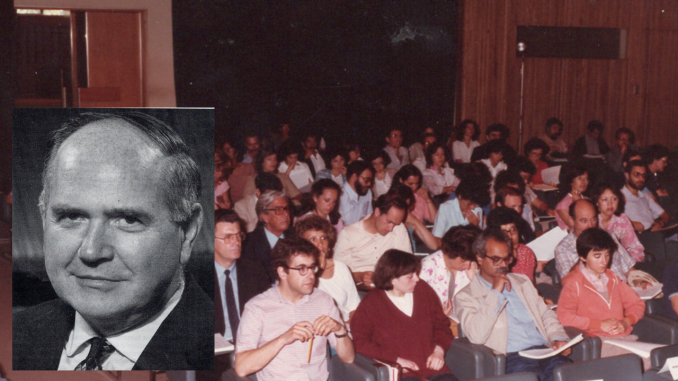


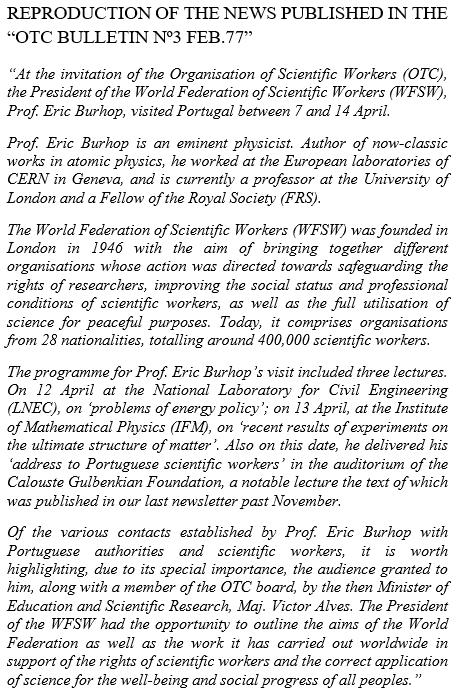
ADDRESS TO PORTUGUESE SCIENTIFIC WORKERS
BY E. H. S. BURHOP[1], APRIL 1976
It is a pleasure and privilege to come to Portugal and especially to speak to scientists engaged in building a new Organization of Scientific Workers. In Britain we have rejoiced in the victories of the Portuguese people, – soldiers and civilians – over the hated fascist dictatorship. We have admired the courage and determination with which you repulsed the attempts of reactionary generals and others to reverse the course of history and re-establish the old conditions. We have watched anxiously as you have had to face mounting problems, both political and economic. We recognize these as teething problems and have never doubted your ability to overcome them.
These basic changes have made it possible for you to set up an organisation of scientific workers concerned to look after the material and cultural interests of scientists, to foster progressive ideas in science education and to work for the application of science and technology exclusively for peaceful constructive purposes. These aspirations are entirely in line with the aims of the World Federation of Scientific Workers. (W.F.S.W.).
| The preamble to the Constitution of the WFSW states : «The primary aim of the scientific bodies which subscribe to the Constitution of the WFSW is the increase of human welfare through the application and development of science. Scientists can no longer passively acquiesce in the misuse of science, which not only brings about unnecessary suffering and waste, but also impedes the advancement of science itself. Science can only be fully used for the betterment of mankind in an era of peace and international co-operation, and scientists have, therefore, a responsibility greater than that of the ordinary citizen in maintaining stable political relations between nations. …» |
In support of this general statement the objects of the Federation are elaborated more specifically in the body of the Constitution as follows:-“(a) To work for the fullest development of science and technology and for their maximum application to the urgent problems of our time, including the achievement of world peace and disarmament and the rapid increase of food and energy resources.
(b) To promote international co-operation in science and technology in particular through close collaboration with the United Nations Educational, Scientific and Cultural Organisation.
To promote co-operation between advanced and developing countries in the interests of their peoples, international collaboration and peace. Also to assist, as far as possible, in the advancement of science and technology in developing countries and in the provision of aid.
(c) To encourage the international exchange of scientific knowledge and of scientific workers.
(d) To preserve and encourage the freedom and co-ordination of scientific work both nationally and internationally.
(e) To encourage improvements in the teaching of the sciences and to spread the knowledge of science and its social implications among the peoples of all countries.
(f) To achieve a closer integration between the natural and social sciences.
(g) To improve the professional, social and economic status of scientific workers.
(h) To encourage scientific workers to take an active part in public affairs and to make them more conscious of and more responsive to, the progressive forces at work within society.”
Of course Portuguese scientists are by no means unknown to the WFSW. For many years Diálogo was one of our affiliated organizations and when as a result of the fascist oppression this Association had to disband we continued our contacts through a number of Corresponding Members. On behalf of the Federation I wish to pay a tribute of respect to all those who even in the darkest days remained faithful to the principles for which our Federation stands and courageously continued to maintain their connection with it. I cannot mention them all by name but I must refer especially to Dr. J.G. Teixeira who during all this period has attended meetings of the Federation and enabled us to maintain contact with Portuguese scientists. We have tried to assist Portuguese scientists throughout this period by the means available to us, by intervening with the Fascist authorities on behalf of imprisoned colleagues, by studying and publicising the methods used by the Fascists in their colonial wars against the peoples of Mozambique, Angola and Guinea-Bissau, and by attempting to obtain better facilities for the work of Portuguese scientists.
I should like to take advantage of this opportunity to tell you something about the history and aspirations of the WFSW and the way in which it tries to assist scientists all over the world in activities inspired by the principles set out in its Charter and Constitution and which I have just read to you.
The Federation was launched at an inaugural conference held in London on 20/21, July 1946 under the chairmanship of the notable physicist, Nobel laureate, and later President of the Royal Society, Professor P.M.S. Blackett. The immediate impetus to the launching of the Federation was the decisive role science had played in the war in the development of nuclear weapons, of radar, penicillin, etc., the profound uneasiness and sense of guilt among scientists in relation to the role they had played in developing the nuclear weapon that had caused such misery and destruction in Hiroshima and Nagasaki, and especially the realisation that when it came to the point of decision the physicists who had worked on the development of the atomic bomb were impotent to determine its use. There was the realisation that we were then on the threshold of new scientific and technical break-throughs in several areas – leading to what is now generally referred to as the scientific-technological revolution. There was also the feeling that the status and rewards of scientists, especially in government and industry, needed improvement.
The idea of creating an international body of scientists conscious of the social role of science had in fact emerged in the 1930’s, before the Second World War. Exchange of letters and visits had taken place between British and French Associations of scientists and between outstanding scientists like Blackett, Bernal, Needham in the U.K., and Joliot-Curie, Langevin in France.
At the inaugural meeting of the Federation representatives of organisations of scientific workers in 16 countries attended.
One of the first tasks was the setting down in writing of the principal ideas and philosophy of the Federation. This task was given to the distinguished physicist and crystallographer, J.D. Bernal, author of the “The Social Function of Science”. Two basic documents were adopted, the Charter and the Constitution. Quotations from the latter have already been given. It is remarkable that despite the elapse of 29 years and the explosive growth of science and technology during that time, these documents retain their relevancy today.
There are currently 37 affiliated organisations actively working with the Federation in the following 26 countries:- (Bulgaria, Colombia, Cuba, Czechoslovakia, Egypt, Finland, France, Federal German Republic, German Democratic Republic, Greece, Hungary, India, Japan, Korea, Malagasy Republic, Mongolia, Netherlands, Poland, Romania, Spain, U.K., USA, USSR, Vietnam, Yugoslavia. We also have affiliated an organisation of Esperantist scientists.) In 30 other countries the Federation has individual corresponding members. I should mention that we have affiliated organisations also in Albania and China. We have heard nothing from them for 8 years and they have not paid affiliation fees during that time. We have never failed to send them all our papers and we should very much welcome them back as active members. We had an organisation in Chile but this was suppressed at the time of the military coup.
Affiliated organisations are of different types. Some are trade unions, others professional organisations, or organisations interested in the social role of science or the social responsibility of scientists. Still others are organisations for the spread of scientific knowledge, the popularisation of science. The size of the various organisations varies considerably. In many of them scientists are organised alongside non-scientists. For example, our British affiliate, the Association of Scientific, Technical and Managerial Staffs, is a large trade union with 300,000 members. About 25,000 of them are qualified scientists with university degrees or equivalent qualifications. This organisation is affiliated on the basis of a membership of this size and the affiliation fee they pay is calculated on this basis. Of course we define the term scientists widely to include both natural and social scientists as well as engineers. On such a basis it can be said that the WFSW brings together, through its affiliated organisations, approximately 400,000 natural and social scientists and engineers.
In order to prevent one or two very large organisations from dominating the Federation our Constitution lays down that at meetings of the main policy-making body, the triennial General Assembly, the maximum voting power of the country having organisations with the largest membership is 8 votes; the minimum for a country having a single affiliated organisation with the smallest membership is 5 votes.
The nature of the affiliated organisations determines their special contribution to the work of the Federation, but policy decisions are taken collectively, often on the advice of specialist standing committees of which at present there are three, on Socio-Economic policy, on Disarmament and on Science policy.
The membership of the Federation is open to any organisation of scientific workers that accepts the principles of the Charter and Constitution. Strict rules operate to protect the autonomy of affiliated organisations. By the terms of the Constitution no interference in the internal affairs of the affiliated organisation is permitted. Indeed no public statement can be issued on behalf of the Federation referring to the policy of a Government of a country in which the Federation has an affiliated organisation without full prior consultation with that organisation. The right of public utterance on behalf of the Federation is strictly controlled and must be confined to topics specifically referred to in the Charter or Constitution, to matters on which a policy has been expressed in resolutions of the General Assembly or Executive Council, or to non controversial interpretations or expressions of such policy statements. Each meeting of the General Assembly elects an Executive Council of 30 members, as well as the officers of the Federation. Between meetings of the Assembly the Executive Council, which meets at least annually, acts on its behalf, while between meetings of the Executive Council a smaller Bureau is responsible for the day to day running of the Federation although all important matters of principle or matters that could be controversial are referred to the Executive Council for decision by post.
To co-ordinate the work of the Federation in particular regions where the problems may be similar and perhaps rather unfamiliar to scientists from other regions, and to facilitate the growth of the Federation in a particular region, Regional Centres may be set up by the General Assembly, each with its own Head and Secretary. Considerable autonomy is possible for the Regional Centre to carry out the policy of the Federation in its own region. At present there are functioning Regional Centres for Eastern Europe in Prague, for South Asia in Delhi and for the Arab world in Cairo. The central office is in London and the Secretary General lives in Paris, so that it has not been felt necessary to set up a specific Regional Centre for Western Europe.
The Federation carries out its activities through its organ, Scientific World, through the work of its three Standing Committees and through the organisation of Symposia held at intervals averaging 12-18 months. The Federation is concerned to promote freedom for scientists to carry out their work without discrimination based on irrelevant grounds of race, creed, politics, etc. We receive many complaints of such restrictions affecting scientists in many countries. Whenever such a complaint is brought to our attention concerning a country in which we have an affiliated organisation we invariably refer the matter to that organisation, inviting their comments, and asking them to take any action they think appropriate. We offer to take action on the part of the WFSW if they think it appropriate. Sometimes our affiliated organisation, after investigation, draws our attention to other factors in the case which put a different light on the situation. The WFSW cannot, of course, take any action in such a matter against the express wishes of the affiliated organisation concerned.
Sometimes the affiliated organisation is very anxious for the Federation to support its own actions against abuses in its own country. This has happened recently in relation to our affiliated organisation in the Federal German Republic. They have campaigned vigorously against a new Federal law which denies the right of employment in government or university service to judges, lawyers, teachers, natural scientists, if they are members of, or associated with, completely legal left-wing parties, including the German Communist Party and even the left-wing of the ruling Social Democratic Party. Under this law many hundreds of such professional people have been refused employment, including some of considerable eminence. The WFSW will certainly give its fullest support in the campaign and will assist in any way open to it.
The principal interests of the Federation are reflected in the links established with other international organisations. In recent years it has greatly strengthened its links with UNESCO, with which it has the highest consultative status (A). It has consultative status also with the Social and Economic Council of the United Nations Organisation, and consultative relations with the ILO. It maintains contact with international trade union centres on questions of mutual interest.
The Federation is financed through the affiliation fees paid by member organisations. These fees are based on the number of scientifically qualified members of the organisation. Since organisations come from countries with vastly different wealth and living standards it would be grossly unfair to have a uniform basis for calculating the affiliation fee of each member organisation. Also some organisations have great difficulty in sending money abroad owing to exchange regulations operating in their country. The actual fee payable is therefore decided by negotiation with the Treasurer, taking account of all these relevant factors. A balance sheet is published annually and is available to each affiliated organisation.
Turning now to activities of the Federation, the most sustained activity that has been going on ever since the foundation of the Federation has concerned disarmament and the abolition of nuclear weapons. I select for special mention some of these activities.
The Federation played a decisive role in relation to the formation of the Pugwash Movement of scientists against nuclear weapons. Following the decision of an Executive Council meeting in 1954, Professor Frédéric Joliot-Curie, then President of the WFSW, asked me to take responsibility for the organisation of a world conference of scientists of outstanding eminence to meet together and issue a statement warning the world about the dangers of nuclear weapons. On behalf of Joliot-Curie I made contact with Bertrand Russell, who at first felt a better way would be to issue a statement. As a result of these negotiations he was persuaded to do both. He drafted the statement that eventually became known as the Russell-Einstein statement because Einstein added his signature to it the day before he died. In the statement he included a summons to the world conference of scientists as requested by the WFSW. We helped him to obtain signatures for the Russell-Einstein statement from scientists close to the WFSW.
A small organising committee, under the chairmanship of Russell himself, and consisting of my immediate predecessor as President of the WFSW, Professor C. F. Powell, Nobel Laureate in Physics, J. Rotblat and myself was set up to organise the conference. We carried out the negotiations with Mr. Cyrus Eaton, who largely financed the first conference at his family home in Pugwash, Nova Scotia, Canada. The WFSW was instrumental in ensuring the attendance of a strong Soviet delegation as well as a delegate from the People’s Republic of China. It therefore played a vital role in preparing the ground for the first meeting between leading scientists in both the USA and the USSR responsible for advising their respective governments on policy matters related to nuclear weapons. The Federation of American Scientists and the group in Chicago around Leo Szilard and E. Rabinowitch were responsible for bringing in the U.S. scientists.
Since the first meeting there has been no organisational relation between the WFSW and the Pugwash Movement although our President, Professor C. F. Powell, served as Chairman of the Continuing Committee of the Pugwash Movement until his untimely death in 1969. I would refer also to the preparation of the brochure “Unmeasured Hazards” by the Federation as part of the campaign to secure the stopping of nuclear tests. As part of this campaign, in 1959 we wrote to the Heads of State of the USA, USSR and the U.K. requesting that they should receive an international scientific delegation to explain the urgent necessity of banning all tests of nuclear weapons. Only Mr. Krushchev agreed and on 20th May 1959 a delegation of 18 scientists from 9 countries, were received by him. The meeting was preceded by a very informative discussion, leading up to the preparation of an agreed statement on nuclear tests. This was presented to Mr. Krushchev and a vigorous discussion with him, lasting 1½ hours, ensued.
Two important Symposia have been held on problems related to disarmament in recent years. The first was held in Berlin in November 1971 under the title “ABC Weapons, Prospects for Disarmament and the Responsibility of the Scientist” and was attended by about 150 scientists. It was a very useful meeting. The second was held in Moscow in July 1975 under the heading “The Role of Scientists and their Organisations in the Struggle for Disarmament”. It was the largest, best organised and possibly the most successful Symposium yet organised by the Federation. It was attended by 425 scientists from 62 countries – in fact the largest manifestation of scientific workers in support of real progress towards disarmament yet held. We were very glad to welcome several participants from Portugal. At the final plenary session an Appeal to Scientists of the World was adopted by acclamation. This appeal forms the basis of a worldwide campaign of scientists throughout the world in support of the struggle for disarmament. Fifteen Nobel Laureates have given their support to the Appeal.
On 10th September I had the honour to be received in New York by Mr. Kurt Waldheim and I presented all the main documents from the Symposium to him. He showed great interest and reiterated the support for our efforts which he had expressed in his message on the occasion of the opening of the Symposium[2].
[Manuscript addition: Meeting with co-chairman of the UN Conference of the Committee on Disarmament (CCD)]
As already indicated the work of the Federation in the disarmament field goes on all the time through the Standing Committee on Disarmament. In 1974 this committee published a short book under the title “Chemical Weapons Must Be Banned”. This is a summary of the development of chemical weapons right up to the most modern binary weapons and argues the case for concluding a treaty banning the continued research and production of chemical weapons along the same lines as the treaty banning biological weapons.
The second area in which the WFSW has been very active in recent years concerns the question of the rights of scientific workers. Many of the largest organisations affiliated to the WFSW are trade unions so that it is natural that questions of status and conditions of work of scientific workers would attract the attention of the Federation. Such rights are well established in the larger industrial countries but in less developed countries where the profession of science is not so well known, it is not always recognised that conditions of work suitable for many other types of worker are inappropriate for the scientific worker. For example the scientific worker needs access to libraries and available time to make use of them. He needs support for attending scientific conferences and meeting scientific workers from other places engaged in similar work. His rights with respect to patents need protecting, he needs adequate paid holidays and since a lot of his work is brain work, done both at work and at home, clocking on and off at fixed times is not suitable. Bearing factors such as these in mind, the WFSW drew up a Declaration on the Rights of Scientific Workers which was adopted at the 9th General Assembly of the Federation held in Paris in April 1969.*
Meanwhile UNESCO had become interested in this problem and at the 15th meeting of its General Conference in 1968 a resolution was adopted calling on the Secretariat “to undertake studies on the professional status and career conditions enjoyed by scientific and technological personnel, together with the International Council of Scientific Unions, the World Federation of Scientific Workers and other appropriate international non-governmental organisations.”
In its report to the 16th General Conference of UNESCO in 1970 the committee studying this question, referring to our Declaration on the Rights of Scientific Workers, said “… the WFSW document represented, at the non-governmental level, the most complete summary then available of thinking on the rights of workers engaged in various kinds of scientific activity.”
Eventually at the 18th General Conference of UNESCO the Recommendation on the Status of Scientific Researchers was adopted. And so an enterprise very largely inspired by the patient activity of the Federation over many years received official sanction and governments were asked by UNESCO to see that its terms were abided by in their countries.
A great deal of the work in relation to this Declaration was handled for the Federation by the Standing Committee on Socio-Economic Policy. This committee has also been instrumental in establishing co-operative relations with the World Federation of Trade Unions. Two meetings between officers of the two Federations have been held. At the second of these, held in October 1975, it was agreed to co-ordinate our policies on matters related to disarmament and the protection of the environment, and a joint declaration on these matters was adopted.
A representative meeting was also held in 1974 between officers of the WFSW and of the World Federation of Labor, as a result of which it was agreed to maintain contact on matters of common interest. Problems of the environment, the energy and raw materials crises, the population explosion and rate of industrial growth have been discussed in several symposia: Science and the Development of the Economy and Welfare of Mankind (Warsaw, 1959); Relations between Science and Technology (Bratislava, 1969); Problems of Young Scientists (Enschede, Holland, 1971); The Scientist in Society (Varna, Bulgaria, 1973). Vigorous discussions have taken place, particularly at the Symposium about young scientists. These problems have aspects that are the concern of two standing committees; those on socio-economic policy and of science policy.
The Science Policy Committee has also been concerned in the study for UNESCO of the human problems of scientific and technical progress.
The Federation has always been concerned with the encouragement of international co-operation in science and the exchange of scientific information. Exchanges of this nature are, of course, of benefit in the first place because they assist the development of specific research projects in science. But they are also of benefit for the promotion of international understanding, directly between the participants, but indirectly in a wider sphere. The Federation held a European seminar in Vienna (1967) on European Co-operation in Science. These matters will also come under the purview of the Standing Committee on Science Policy when it is working effectively. Unlike the other two Standing Committees this one is only just beginning to come into operation.
Another very successful seminar on Higher Scientific and Technological Education was held in Moscow in 1962. The discussion was at a high level and indeed at least one country (the GDR), made substantial changes in its tertiary education system as a result of the discussions at this Symposium. This topic is also of concern to both standing committees on science policy and on socio-economic policy.
The Federation has much to contribute in relation to problems of concern to developing countries. The Warsaw Symposium of 1959 was partially directed towards these problems, while in 1965 we held in Budapest a Symposium on “Problems of the Advancement of Science in Developing Countries and the Role of International Scientific Co-operation”. While, however, we have affiliated organisations in a number of developing countries, I feel that we really have not yet found the most effective way to assist in these problems of underdevelopment. We are planning to organise a Symposium in India early in 1977 in collaboration with our Indian affiliated organisation and our Indian Regional Centre on “The Obstacles to the Application of Science and Technology to Development in the Less Developed Countries.” If the Federation is to justify its title as a world body we need to devote much more attention to problems of the role of science and of scientists in developing countries.
I should not leave the question of the developing countries without pointing out the very considerable activity of the Federation in relation to Vietnam during the American attack on that country. We launched two appeals for scientific and technical aid for the re-equipment of laboratories damaged in the war. These appeals were launched under the auspices of many eminent scientists, many not connected with the Federation, and resulted in the despatch of about £10,000 worth of aid. In December 1970 a WFSW delegation of six persons, led by myself, went to Hanoi. After the Paris agreements the WFSW sponsored a visit of a delegation consisting of three Vietnamese scientists to Western Europe in 1973 to discuss the co-ordination of scientific and technical aid to their country.
It is appropriate here also to report on action with respect to the unworthy role certain very eminent U.S. physicists played in support of the policy of their government in Vietnam. They worked on the so-called Jason Committee of the Institute of Defense Analysis, which was concerned in part in developing new military techniques for use in Vietnam. On behalf of the WFSW, therefore, I wrote personally to each of the 40 participants (including six Nobel Laureates) inviting them to explain how they could justify to their consciences their participation in the work of the Committee. The replies received from eleven of the participants were of great interest and have been analysed in an article “Scientists as Soldiers” in the November 1971 issue of the Bulletin of the Atomic Scientists. A wide variation between the extent to which Jason participants gave serious consideration to the implications of their participation was revealed. Some did give much serious consideration and concluded they could no longer continue to work with the Jason Group because of their opposition to the cause being served by their work – the support of the U.S.A war effort in Vietnam. One however wrote “I fully approved of the United States’ endeavour to protect South Vietnam”. (This from a Nobel Laureate, one of the most eminent living theoretical physicists). Some felt that although they disliked the U.S. involvement in Vietnam, they could influence the technical direction of the involvement by continuing to work with the group. Some felt it was, in any case, the duty of scientists to serve a democratically elected government to ensure the best scientific advice was available to it. Still others did not give evidence of having thought much about the matter at all. Presumably the seventy-five per cent of Jason participants who failed to reply included many who had not concerned themselves overmuch with the moral issues involved. One suspects that many drifted into the work because it was technically interesting, challenging and lucrative and satisfied their ego. It is just this so-called “value-free” attitude that has given rise to a distrust of science and scientists, especially among idealistically motivated youth.
In all the work of the Federation its journal, Scientific World, plays a most important role. It is published in identical editions in English, French, German and Russian and an Esperanto edition is about to commence. Unfortunately we have no effective means for its distribution in Britain and France so that the circulation is low (English 3,000, French 500, German 15,000, Russian 8,000). The WFSW fulfils functions not fulfilled by any other organisation. It is true, of course, that since it was founded international scientific co-operation has increased greatly. The international scientific unions organised at subject level and whose activities are co-ordinated through the International Council of Scientific Unions (I.C.S.U.) organise very many international conferences and provide for international scientific contacts at the professional level. UNESCO, with its great resources is able to organise international meetings to discuss problems of scientific policy and its impact on society at government level. The Pugwash Movement of which the WFSW was one of the parents plays a useful role by arranging international contacts between top scientists on an unofficial personal basis to discuss problems of nuclear weapons, disarmament, development, international scientific co-operation, but scientists attending Pugwash meetings do so as individuals. Organisations are not invited to be represented.
The strength and unique character of the WFSW comes from the fact that it is based, not on individuals, but on organisations. The scientists who attend its meetings are selected by the organisations they represent. They do not attend as nominees of their governments nor do they speak on behalf of their governments. The Federation tries, and almost always succeeds, to work through consensus on all important questions. This is not always easy when one considers the wide differences between social and economic systems, ideologies and levels of development of the countries from which our member organisations are drawn. But the fact that we have succeeded in continuing our work for 30 years and have survived the difficult years of the cold war, while at the same time carrying out many activities of a socially useful nature, shows, I believe, the strength and validity of the ideas set out in our Constitution and Charter. Our Founder-President, the great Joliot-Curie, at the height of the cold war, emphasised the role of the Federation as the keeping alive of contacts and building bridges between organisations of progressively oriented scientists, which, however they differed in other respects, sincerely believed in the principles of our Charter and Constitution.
Of course it is easier to enunciate general principles than to formulate a policy on day to day problems, consistent with those principles. We certainly make mistakes and we cannot take action on all things we perhaps should. Undoubtedly one of the main weaknesses of our work is financial. The annual budget for the whole Federation is about 40 thousand dollars – very small in relation to the scale of our activities. Indeed it is only possible to carry on because almost all the work of the scientific officers is voluntary and unpaid, and even the technical staff accept salaries much lower than is due to them because they feel the work is worthwhile.
I have greatly welcomed the opportunity to come to Portugal to meet you while you are in the process of forming the Organization of Scientific Workers.
I hope it will be possible for a Portuguese delegation to come to our Eleventh General Assembly which is to be held in London next September. The contacts provided by meeting like-minded scientists from many other countries at our meetings is an important advantage of membership of the Federation. The cross-fertilisation of ideas helps both the work of the movement in individual countries and that of the Federation itself.
Dear friends and colleagues, we are living in difficult times for science and scientists. We have achieved some of the things for which we have fought but in some of the major areas of the programme a tremendous amount remains to be done. The arms race shows no sign of slowing down and even more sophisticated weapons are being developed with the assistance of many scientists and engineers in many countries. Problems of pollution of the environment, prodigal use of scarce resources, the population explosion all involve the work of the scientist and the social relations of science. New scientific discoveries like that of gene manipulation raise ethical problems of great importance. Although we had thought the potential uses of science for the happiness and benefit of mankind had been amply demonstrated, we have seen a new and vigorous anti-scientific movement spring up around us. At a time when the manifest problems of our society require more science and technology of the right kind for their solution, we see in many countries unemployment and redundancy among scientists and a reduction of the numbers of young people coming forward to study science in our Universities.
In some ways it seems to me there is more need today for an international organisation working in support of the principles of our Charter and Constitution than there was in 1946 when it was founded. We need new vigour, new ideas, new imagination in order to build up organisations of scientists in many more countries to work for these principles. Over the years I have come to value and admire the courage, dedication and enthusiasm of the Portuguese scientist I have met at our meetings. You can bring new ideas and new directions to the work of the Federation and I look forward very much to your playing an increasingly active role in our meetings and in the formulation of our policies. We need you, and I hope in return we can, by putting you in touch with other associations of scientific workers all over the world, provide you with new horizons for your work in Portugal, and indeed in the Iberian Peninsular, because as you know we already have an affiliated organization, The Association of the Personal Investigator of the Higher Committee for Scientific Research (CSIC) in Spain and it would be very appropriate if the two organizations could establish contact.
Once again may I thank you for inviting me to visit you. It has been a memorable experience for me. And let me congratulate you on your initiative in forming the Organization of Scientific Workers and on the programme of activities you have formulated in support of the principles in which you believe.
Lisbon, April 13, 1976
Original document in PDF format: https://otc.pt/wp/wp-content/uploads/2026/10/Burhop-Em-Lisboa.pdf
[1] Prof. Eric Burhop was the third president of the WFSW (1971–1980), succeeding the British physicist Cecil Powell and Frédéric Joliot-Curie, the latter being the first president. Both were Nobel Prize laureates, in Physics and Chemistry respectively.
[2] OTC Note: Kurt Waldheim, an Austrian national, was the United Nations Secretary-General at the time. The original document also contains a handwritten note in the margin referring to a meeting with the co-chair of the United Nations Conference of the Committee on Disarmament. Other handwritten passages visible in the original typewritten document have been incorporated into the transcription presented here.


